How we respond to life is everything—and yet, response is often the hardest thing to govern.
By virtue of being human, we emote. We react to our environment largely through conditioning. We are taught, consciously and unconsciously, how to respond to what we see, hear, feel, taste, and touch. When those responses become ingrained—played on repeat until they no longer require conscious thought—they enter a state of automaticity. The script runs on its own. In many situations, the only true agency we retain is not over what happens to us, but over how we respond to it.
A Mother’s Reflection
As the mother of a young boy, I witness this process in real time. I see how the world presses against him, how easily feelings arise when things seem unfair or when desires go unmet. At times, the world feels less welcoming to him—and that, too, is normal. Our bodies register perceived pain through emotion, often sadness, though pain itself is subjective and deeply personal. Any stimulus that triggers that feeling elicits a response. For him, that response may show up as anger or tears, and at his age, that is entirely expected. He has not yet learned how to regulate those emotions or to recognize that there is a more constructive way to express them. That understanding must be taught.
Withstanding Emotional Weather
There have been moments when I’ve interrupted him in the midst of his emotional storm—not to suppress his feelings, but to help him navigate them. I tell him it is okay to feel angry, but not to express that anger in ways that harm himself or others. It is okay to cry, but not to allow those tears to pull him into a sorrow he cannot emerge from. I want him to understand that while we may not choose our feelings, we do choose how we respond to them.
Caught in My Own Downpour
What humbles me is that while I stand in a position of guidance, charged with helping him learn how to face life’s challenges, I am still learning myself. Even at my age, I sometimes struggle with responsiveness. I react when I should pause. I allow emotion to surge where reason should stand firm. And that, too, is part of the journey. Growth does not eliminate obstacles; it simply sharpens our ability to recognize them as they appear.
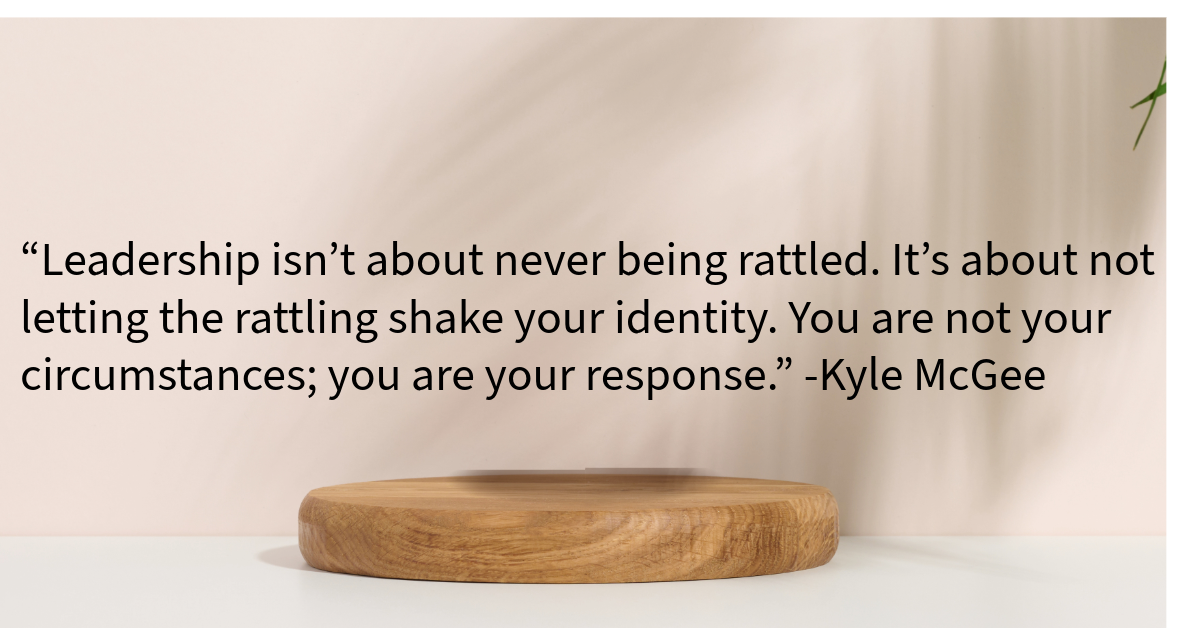
While reading a particularly poignant book entitled “Built to Lead: Forged by Purpose, Fueled by Faith,” one passage settled deeply within me:
That truth resonated profoundly.
Your Response is Your Signature
For anyone striving to become a better version of themselves, for anyone who looks at life and feels powerless—remember this: there will always be one thing within your control. Your response. Let that response reflect who you are, or, if you are still becoming, who you aspire to be.
A vice is a strong and consuming desire that leads to feelings of shame and guilt when acted upon. To qualify as a vice, a set of established moral principles must dictate certain behaviors as undesirable or unacceptable. These principles can be shaped by the individual’s own conscience, someone they look up to and respect or a societal code. Even when trying to resist the strong temptation, the person ends up giving in, leading to feelings of shame and guilt. This unrelenting desire becomes a vice—an insatiable craving for something unethical or immoral, a willful betrayal of societal norms and laws.
The Fallacy of Discipline
Contrary to common belief, stricter avoidance methods and harsh punishments do not effectively eradicate vices entirely. Instead, they may even exacerbate the problem by driving individuals further into secrecy and denial.
With lying, you avoid dealing with a problem by claiming it isn’t true. If you are caught, you’ll deal with it later.
With avoidance, you lie to yourself by putting something off that’s to be dealt with now.
Lying involves words; avoidance involves deeds.
Both are normal from a developmental point of view. But, if we fail to grow out of them, we suffer. Neither technique works in adult life.
These measures only provide temporary relief and fail to address the underlying issue. Despite strong self-discipline and personal standards, moments of temptation can still sneak in and linger like a heavy fog.
From Yearning to Liberation
The struggle to resist intensifies as the yearning deepens, taunting and enticing further. When someone finally gives in, a wave of guilt sweeps them away. How can one liberate themselves from the grip of a detrimental habit?
There needs to be a deeper change or understanding (transformation).
Transformation requires a deep internal change and acceptance of external situations, transitioning from old habits to new beginnings.
Genuine change is a complex process that requires internal transformation and acceptance of external circumstances. It is like shedding an old skin and embracing a new identity. To overcome a destructive habit, you need to introspect deeply, identify the underlying reasons for the desire, and address them at their core. This is no easy task, but once the desire has been uprooted, the harmful behavior will also fade away.
The key to lasting change is for a person to reach a state where engaging in such actions no longer brings them joy (pseudo satisfaction).
For example, if someone is trying to quit smoking, they may need to delve into their past traumas or triggers that cause them to turn to cigarettes for comfort. By addressing these underlying issues and finding healthier coping mechanisms, they can slowly overcome their addiction and eventually reach a point where smoking no longer provides them with any satisfaction.
This internal transformation and acceptance of external circumstances are essential for genuine change to occur—not because they are following rules or restrictions, but simply because they have no desire for them anymore.
True Alignment
On the other hand, one could also embrace one’s desires and acknowledge that one does not conform to the norms of those around them. One may begin to recognize that one’s beliefs and values differ from those around them, causing inner conflict and perhaps a sense of shame.
By distancing themselves from those who condemn their desires or hold conflicting ideals, they can create space for self-acceptance and alignment with their ethics, beliefs, and behaviors. This journey towards authenticity and self-discovery is powerful as it enables individuals to align their actions with their true values and beliefs, empowering them to live authentically.
For example, a person may realize that their passion lies in pursuing a non-traditional career path, such as becoming an artist or entrepreneur, instead of conforming to the expectations of their family or society. Staying in the space where your inner beliefs constantly conflict with those surrounding you will cause pressure. You are in a constant battle to be yourself, as in being yourself and believing what you do is condemned.
The Perils of Inauthencity
By surrounding themselves with supportive friends and mentors who share similar values, one can cultivate the courage to embrace their unique aspirations, likes, and dislikes. This shift towards authenticity not only brings a sense of fulfillment and purpose but also ultimately leads to a more genuine and meaningful life experience.
Living as someone other than your true self and behaving in ways that go against your nature invites a simmering rage and an overwhelming sense of resentment leading to inner turmoil. This internal turmoil bubbles and boils like a cauldron of self-loathing, threatening to consume and crush the person under its weight. It eventually drives the individual towards the things they despise. They may seek revenge on those who set the principles as they feel betrayed.
The Power of Integrity
However, conquering vices demands an unwavering commitment to integrity. An internal moral compass must serve as a guide for thoughts and actions that are in line with unwavering belief. You must know yourself and then decide to be true to what you know. If you cannot live without something, change your community of those who accept it, and you will lose the shame. If you know that it stems from a place that requires adaptation, then you commit to the work of eliminating the emptiness. If you know that the emptiness stems from a wound that needs healing, then you commit to the work of self-discovery and growth.
Establishing a supportive community of people who share your values and aspirations eliminates the need for rules or laws from outside sources because those who live by their principles feel unrestricted in their actions. When one follows one’s own path, guided by inner goodness, everything falls into place effortlessly—doubts dissipate, challenges diminish, and one evolves into an unstoppable force progressing towards genuine and pure righteousness.
I talked with a friend today about identifying purpose. It was quite meaningful. This is something that many people spend a lot of their lives trying to discover. Why are we here?
I venture to say that often there is a disconnect. What many think of as purpose they are actually thinking of occupation. People often mistakenly believe that their purpose and their occupation are synonymous.
One may feel they are purposed to be a doctor, lawyer, preacher, or run a business. Some may even equate talent and purpose.
A talent for doing hair, for athleticism, or the performing arts to them means purpose.
What if none of those acutally defined purpose?
What if all of those things (occupation/talent) were simply avenues to help humans fulfill a purpose?
The Essence of Purpose
Bear with me a minute!
I believe purpose is something much deeper; than what you choose to do earn money.
Talent is a gift but not a purupose. Occupation is a choice. How we desire to exercise our talents.
Purpose is actually what drives human progress. It is the enriching ideal of nourshing others so that we all may be better all (live a more fulfillin existence)
Purpose is ultimately universal. and one specific objective.
Purpose is relatively the same for everyone: to contribute to humanity’s growth and progress in some form, whether it be through the saving of the spirit, body, mind, or soul.
Talents and Purpose
Our talents help determine in which way we can better help our fellow travelers.
We have been endowed with specific ways that help us to engage, awaken, and move people in areas that others cannot. But we must discover our talents, lean into them, and develop them so that we can find the vehicle that makes it easier to reach the people we were created or born to meet, influence, and inspire.
Career (Occupation) and Purpose
Fundamentally, the occupation we choose is the most superficial component of it all. Our employ is merely a vehicle, a container in which we can sit in our talents, and use to move the mission forward.
While it is the most superficial its also the most troubling. To be content in life one’s talents must align with chosen career.
When our choice (occupation) does not align with our gift, then we struggle to properly fulfill the purpose of helping humanity in the way we were born to do so.
The Power of Alignment
When we discover that thing that we love, passion, which is self-driving (not forced) alignment happens .
Alignment is flow. Alignment is synchronistic.
When things align, there is a force of propulsion.
It takes an enlightened person to understand that if their employ is simply to difficult, in opposition to character, or out of sync with the core, then it most definitely means you are moving in the wrong direction.
Discovering Your True Calling
Joyce Meyers gives a very effective demonstration of this.
As Joyce Meyers notes in her devotional,
“I tried to grow our garden, can tomatoes, and sew my husband’s clothes. I wasn’t at all good at any of these things. And I despised trying; it was obvious that God wasn’t calling me to grow and preserve vegetables or sew. We know we are operating in our gifts and calling when what we do ministers life to others. If what we are doing makes us miserable or feels us with dread, it’s possible we are not in God’s perfect will. “
What it realky means is that what we are attempting to do is not for us. Success will be limited or not all.
You can’t force something to fit where it doesn’t
To Make It Plain
Let us go back to the beginning.
How do you know? you are living out your purpose?
One can look to a very impactful quote from major motion picture, “Fields of Dreams.
In a bit of a paraphrase, “If you build it and they come,” that is the first sign.
If there is joy and contentment in the building then (Eureka) you have found it.





 Inspiraelevation